A concrete driveway in Wausau, WI takes plow blades, road salt and five months of freeze and thaw every year, and sooner or later it starts to flake, crack or sink toward the garage. We're concrete driveway contractors who tear out and replace worn driveways and pour new ones, and the first thing we settle at every estimate is whether yours can be saved or has to come out.
Here's how that call gets made:
- Flaking or pitted surface, slab still flat: salt scaling. Ugly, but the slab underneath can have years left. Cleaning and sealing slows it down.
- A few tight cracks that haven't moved: normal. Seal them to keep water out and leave the driveway alone.
- Cracks with one side higher, a sunken section, a heaved slab at the garage: the base has moved. Surface repairs won't hold. That section, or the whole drive, needs replacement.
- Water standing on it or running toward the garage: the pitch is wrong, and no patch fixes pitch.
If we think yours only needs crack sealing and section repair, that's what we'll tell you. If it's the floor on the other side of the door that's failing, see garage floor repair.
Concrete Driveway Cost in Wausau
Concrete driveway cost comes down to square footage and what's under it. A new concrete driveway built on a proper base typically runs about $10 to $30 a square foot, with tear-out of an old slab adding about $3 to $9 a square foot. Here's what that range looks like on common Wausau driveway sizes, before any of the extras below.
| Driveway | Approx. area | At $10 to $30 per sq ft |
|---|
| Single car, 12 x 24 ft | 290 sq ft | $2,900 to $8,700 |
|---|
| Two car, 24 x 24 ft | 575 sq ft | $5,800 to $17,300 |
|---|
| Two car, 24 x 40 ft | 960 sq ft | $9,600 to $28,800 |
|---|
Typical ranges, not a quote. Your price comes from the on-site estimate.
Where a job lands in that range depends on a handful of things you can see at the estimate: whether there's an old slab to break out, how much soft soil has to be dug out and replaced with base, how far the concrete truck can reach, whether a public apron or sidewalk is part of the job, and the finish. The one thing nobody can see is what's under an old driveway until it's broken out. If the soil underneath turns out to be wet clay or old fill, the base work grows, so it's smart to hold about 10 percent in reserve on a replacement.
Concrete Driveway Replacement, Start to Finish
Driveway Aprons and Curb Cuts: The Permit Part
The apron is the stretch between the street and your driveway, and in most of Wausau it sits in the public right-of-way. That changes the rules for that one piece. In the City of Wausau, building or replacing a drive approach across the sidewalk, boulevard or curb takes a permit from the Engineering Department, and where the street has curb and gutter, the approach has to be concrete. Contractors pouring in the right-of-way also have to be licensed by the city's Board of Public Works, which is a fair thing to ask anyone you're getting bids from.
Width is capped too: a residential drive can't run wider than 30 feet where it crosses the sidewalk line without the city engineer signing off. If the public sidewalk across your driveway is broken, that's the homeowner's to replace in Wausau, and it usually makes sense to do it in the same pour as the driveway rather than as a separate trip. The villages around the city set their own apron rules, so the answer in Weston or Rib Mountain can differ from the one inside city limits.
Source: City of Wausau Municipal Code, Chapters 12.20, 12.28 and 12.32.
Why Driveways Fail in Wausau: Salt, Frost and Base
Wausau sees around 64 inches of snow and about 163 nights a year at or below freezing, based on NOAA's 1991 to 2020 normals. Every one of those nights, water in the top of the slab and in the soil under it can freeze and expand. That's the engine behind the three failures we see most:
- Scaling. The top quarter inch flakes off in patches. Salt and brine tracked in from the street soak into the surface and make each freeze harder on it. New concrete is most vulnerable its first winter, which is why we tell people to keep deicer off it until spring and use sand instead.
- Heaving. A section lifts at a joint or along the garage. That's frost in a wet, silty base. Upland lots around Wausau commonly have a silt loam layer over glacial till, which holds water. The fix is taking the soft material out and replacing it with gravel that drains, not pouring thicker concrete on top of it.
- Settling. A section drops, most often at the garage door or along the house where the soil was backfilled after the foundation went in. Fill keeps settling for years if it wasn't compacted.
Random cracks running across the slab instead of at the cut joints usually mean joints were spaced too far apart or cut too late. Those are decided on pour day, which is why they're worth asking about before you pick a contractor.
Concrete vs Asphalt Driveway
| Concrete | Asphalt |
|---|
| Up-front cost | Higher | Lower |
|---|
| Upkeep | Seal every few years; keep salt off the first winter | Sealcoat every few years; patch potholes and edges |
|---|
| Summer heat | Stays hard | Softens; kickstands and trailer jacks sink |
|---|
| Winter | Salt can scale the surface | Handles salt; edges crumble under plows |
|---|
| Decorative options | Borders, color, exposed aggregate, stamping | Very few |
|---|
Asphalt is the better buy for some properties, a long gravel-road drive out in the country being the usual one, where the per-foot difference adds up fast. We don't pave asphalt, and we'll still tell you if it's the smarter choice for yours.
Driveway Finishes and Add-Ons
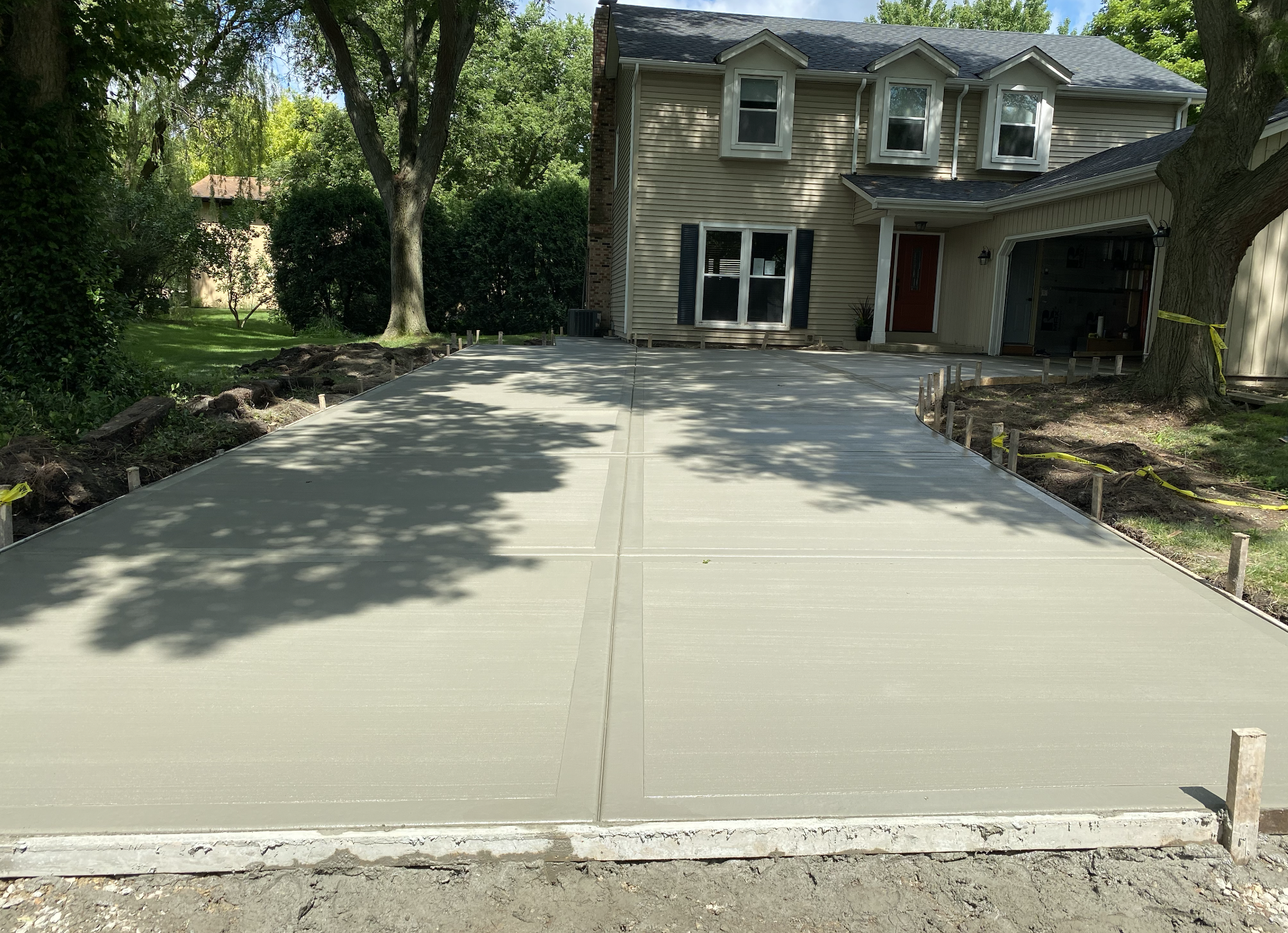
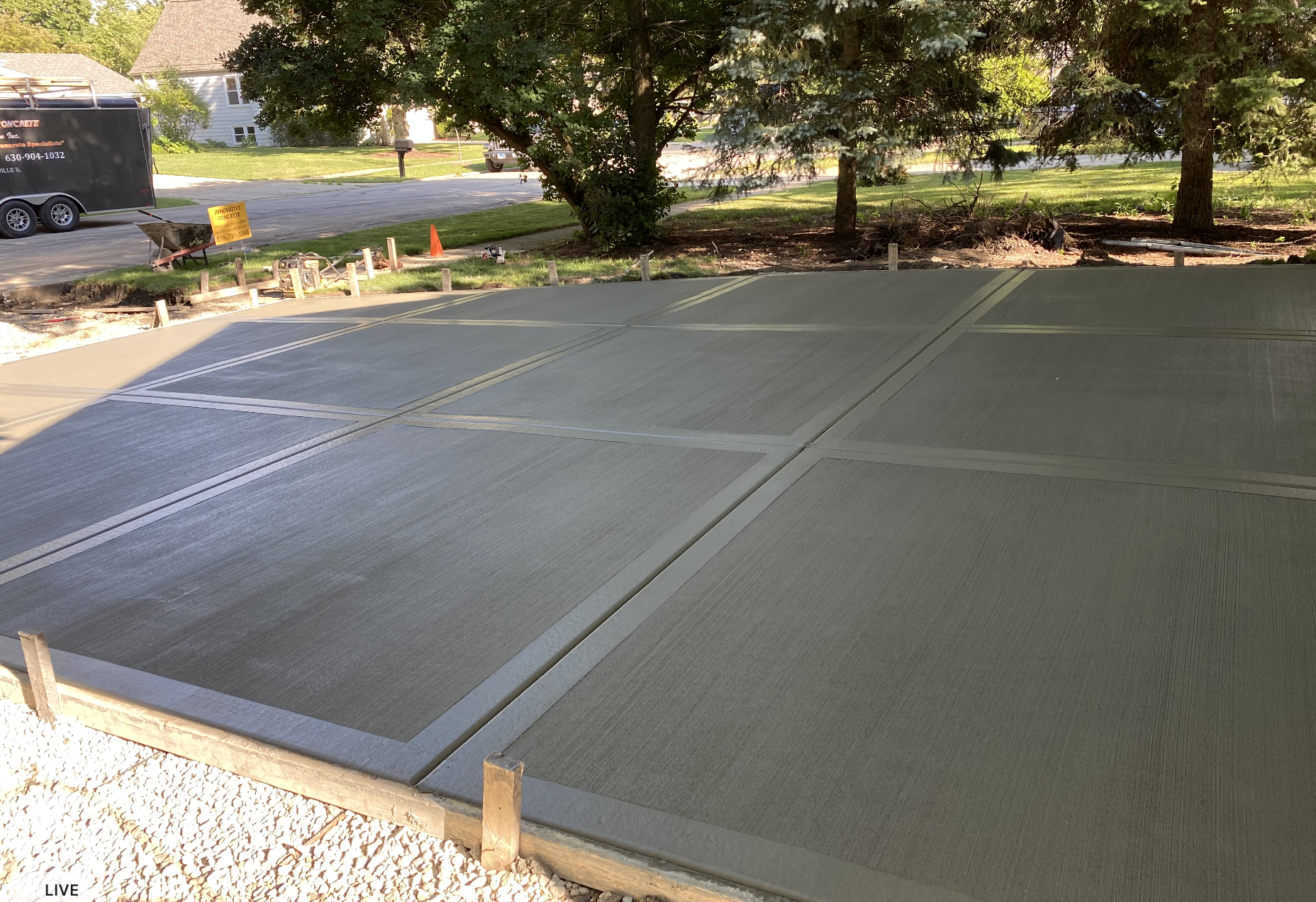
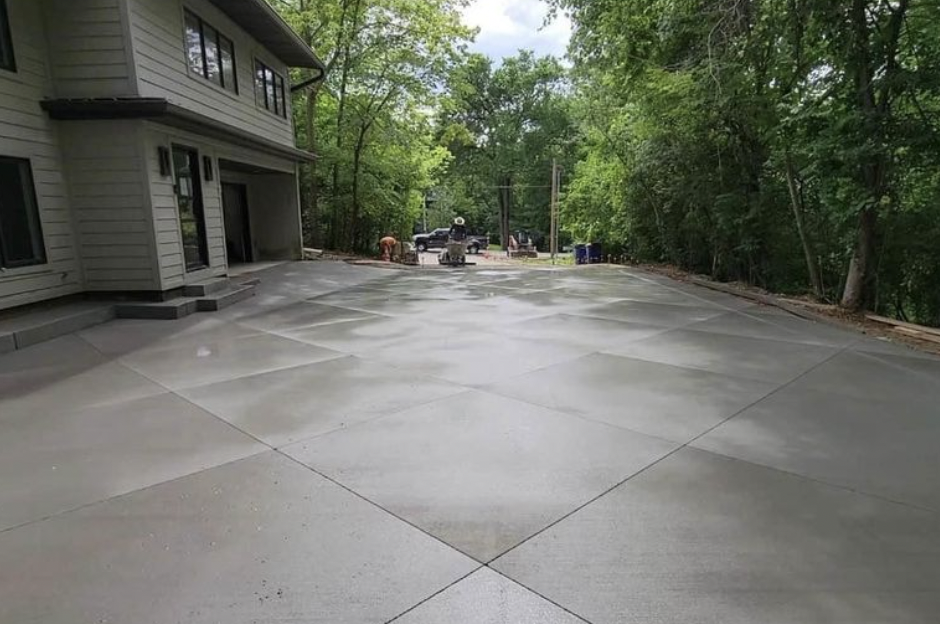
Broom finish is standard and the right call for most drives. Smooth troweled borders, like the ones in the photos above, dress up a plain drive for little extra. Exposed aggregate hides tire marks and wear. A stamped concrete border or apron puts the decorative work where the plow blade doesn't go. Widening a single drive, adding a parking pad beside the garage, or pouring a walk to the front door are easiest to do in the same pour.