
Concrete Repair in Wausau, WI

Crack sealing, patching, single-panel replacement and step and stoop repair, sized to what's actually wrong

Or call 715-814-9520

Get a Free Repair Estimate

Thank you! We received your request and will contact you shortly.

Before you call anybody about a crack, go stand over it. Is it wider than a pencil line? Is one side higher than the other? Has it changed since last spring? Those three answers decide most concrete repair jobs in Wausau, and some of them end with a tube of sealant and no contractor at all.

We repair driveways, walks, patios, steps and stoops: sealing cracks that have stopped moving, patching flaked and broken spots, cutting out a failed panel and pouring a new one, and fixing or rebuilding steps. We won't sell you a replacement when sealing or a section repair will do. Here's how to tell which one you're looking at.

Concrete Crack Repair Starts With Reading the Crack

How to read a crack in a concrete slab and what repair it usually calls for
What you seeWhat it usually meansThe repair
Hairline crack, both sides flush, same as last yearShrinkage from when the slab cured. Nearly every slab has a few.Usually nothing. A penetrating sealer over the slab keeps water out. Too thin for a crack sealant to get into without routing it open.
Open crack, about 1/4 to 1 inch, both sides flushA crack that opens and closes with the seasons, but the slab hasn't dropped.Clean it out, backer rod if it's deep, flexible polyurethane sealant. This is the job crack filler is made for.
One side higher than the otherThe base moved: settled fill, washout, or frost heave under one side.Sealing keeps water out but won't fix the step in the surface. Often the panel comes out and the base gets rebuilt.
Crack that grows every year, or several meeting at a cornerOngoing movement or a slab that's lost support.Find the cause first (downspout, sunken base, roots). Then section replacement.
Wide gap where a slab meets the house or garageThe slab has settled away or shrunk back from the wall.Backer rod and sealant if it's stable; if the slab now tips toward the foundation, it's a pitch problem, not a crack problem.

The one people miss is the offset. A crack with both edges level is a cosmetic and water problem. A crack with a lip is the slab telling you something underneath has moved, and it's also a toe-catcher on a walk. Filling it changes neither. Run your foot across it; if your shoe catches, the repair is about the base, not the crack.

Concrete Crack Filler: What the Tube From the Store Can and Can't Do

Plenty of crack repair is a reasonable do-it-yourself job, and we'd rather tell you that than drive out to fill three cracks. What matters is matching the product to the crack.

Flexible Polyurethane Crack Sealant

For a crack that opens and closes with the seasons, you want something that stretches. Self-leveling polyurethane crack sealants are made for flat slabs: the one data sheet we checked rates its product for cracks from 1/4 inch up to 1 inch wide, about 25 percent movement, a sealant depth of 1/4 to 1/2 inch, and a 2-to-1 width-to-depth shape. It also says plainly it's not for sloped surfaces, so it will run off a step riser or a steep walk; those need a gun-grade, non-sag sealant.

Rigid Concrete Filler and Cement Patch

Cement-based patch and concrete filler cure hard, the way concrete does. That's right for filling a hole or a broken edge that doesn't move. It's wrong for a crack that does: the patch is stiffer than the crack is wide, so the first cold snap cracks it again along one edge, and now there's a seam for water. Rigid filler in a moving crack is the most common failed cement repair we see.

Routing and Backer Rod for Wider Cracks

A crack too narrow for sealant to get into gets routed: cut open with a crack saw or grinder into a clean, square-sided groove the sealant can grip. A crack deeper than the sealant should be gets a closed-cell foam backer rod pushed in first, so the sealant bonds to the two sides and not the bottom. That's what lets it stretch instead of tearing. Skip the backer rod in a deep crack and you've filled it with a plug that pulls loose.

A crack filler from the store is enough when:

  • The crack is roughly 1/4 to 1 inch wide and both sides are level
  • It's on a flat slab, not a step or steep walk
  • It hasn't grown in the last year
  • The concrete on both sides is sound, not crumbling

Call a concrete crack repair contractor when:

  • One side is higher, or the slab rocks underfoot
  • The crack keeps getting wider
  • The edges are breaking off into pieces
  • The slab tips water toward the house

Whatever you use, the crack has to be clean, dry and frost-free, and the sealant goes in when the crack is at the middle of its movement. In practice that means a mild spring or fall day. On a hot July afternoon the concrete has expanded and the crack is at its narrowest, so sealant put in then gets stretched hard all winter.

Repairing Spalled, Scaled and Popped-Out Concrete

Surface damage gets lumped together as "crumbling," but the three kinds below have different causes and different odds of a lasting patch.

Scaled Concrete: Salt and Freeze-Thaw

Scaling is the top skin flaking off in thin patches, often where cars park or where you salt the walk. Water in the top of the slab freezes and breaks it loose, and deicers make each freeze harder on it. Wausau gets about 64 inches of snow and roughly 163 nights a year at or below freezing (NOAA 1991 to 2020 normals), which is a lot of cycles. Lab work for the Indiana DOT found calcium chloride and magnesium chloride solutions did more damage to concrete than plain sodium chloride, and that freeze-thaw exposure was much more severe than wetting and drying. Deicers with ammonium nitrate or ammonium sulfate are worse still; keep them off concrete entirely.

Light scaling on a slab that's still flat is mostly cosmetic. Cleaning and sealing slows it down. Thin patches over scaled spots tend to pop off in a winter or two, so we're careful about selling them. When scaling covers most of a slab, a bonded topping over the whole surface is a separate job with its own limits, and it only makes sense on a slab that isn't moving.

Spalled Concrete at Joints and Edges

Spalling is deeper than scaling: chunks breaking out of an edge, a joint or a corner, sometimes over rusting steel. A spalled edge can usually be repaired. The loose concrete gets chipped back to sound material, the edges get cut square so the patch isn't feathered to nothing, and a repair mortar goes in. Where a joint has spalled because it was packed with stones and sand that couldn't compress, the joint gets cleaned and sealed too, or it will happen again.

Concrete Popouts

A popout is a small cone-shaped crater with a broken piece of stone at the bottom. A porous stone near the surface took on water, froze and blew the top off. Popouts look bad but rarely matter structurally. Each one can be cleaned out and patched, but more tend to follow over the years as deeper stones take on water. Sealing the surface can slow that down; nothing on top of the slab changes the stone inside it.

Concrete Slab Repair: Replacing One Panel, Not the Whole Slab

Most driveways, walks and patios are already divided into panels by their control joints. When one panel has sunk, cracked into pieces or heaved, that panel can usually come out on its own and leave the rest. This is the repair we'd pick over a full tear-out any time the rest of the slab is sound.

Replacing one failed panel in a jointed slab Plan view of a driveway divided into six panels by control joints. The middle panel nearest the street is cracked and sunken. A saw-cut line runs around that one panel along its joints; the other five panels stay in place. GARAGE STREET Control joint Full-depth saw cut Panel replaced
One failed panel out, five good ones left alone. Cutting on the existing joints keeps the new seam where a joint already was.
  1. Find out why it failed. A sunken panel by the garage is often settled backfill; one by the downspout is often washed-out base. If the cause stays, the new panel follows the old one.
  2. Saw-cut full depth on the joints. Cutting along the existing control joints leaves a clean edge on the panels that stay and puts the new seam where one already was.
  3. Break out and haul the old panel. The cut keeps the breaking from cracking the neighbors.
  4. Fix the base. Soft or wet soil comes out, gravel goes in and gets compacted in layers. This step is the actual repair; the concrete is just the lid.
  5. Tie in and pour. Where the neighbors need to stay level with the new panel, steel dowels drilled into their edges keep the joint from stepping up or down. The new concrete is finished to the old pitch so water runs where it used to.
  6. Cure and keep salt off. Cars stay off for about a week. Skip deicer on the new panel its first winter.

The honest catch: a new panel looks new. Fresh concrete is lighter than a slab that's weathered for 20 years, and it won't blend in right away. On a broom-finish drive most people stop noticing in a season or two. On stamped concrete, matching a pattern and color is a different problem with its own page.
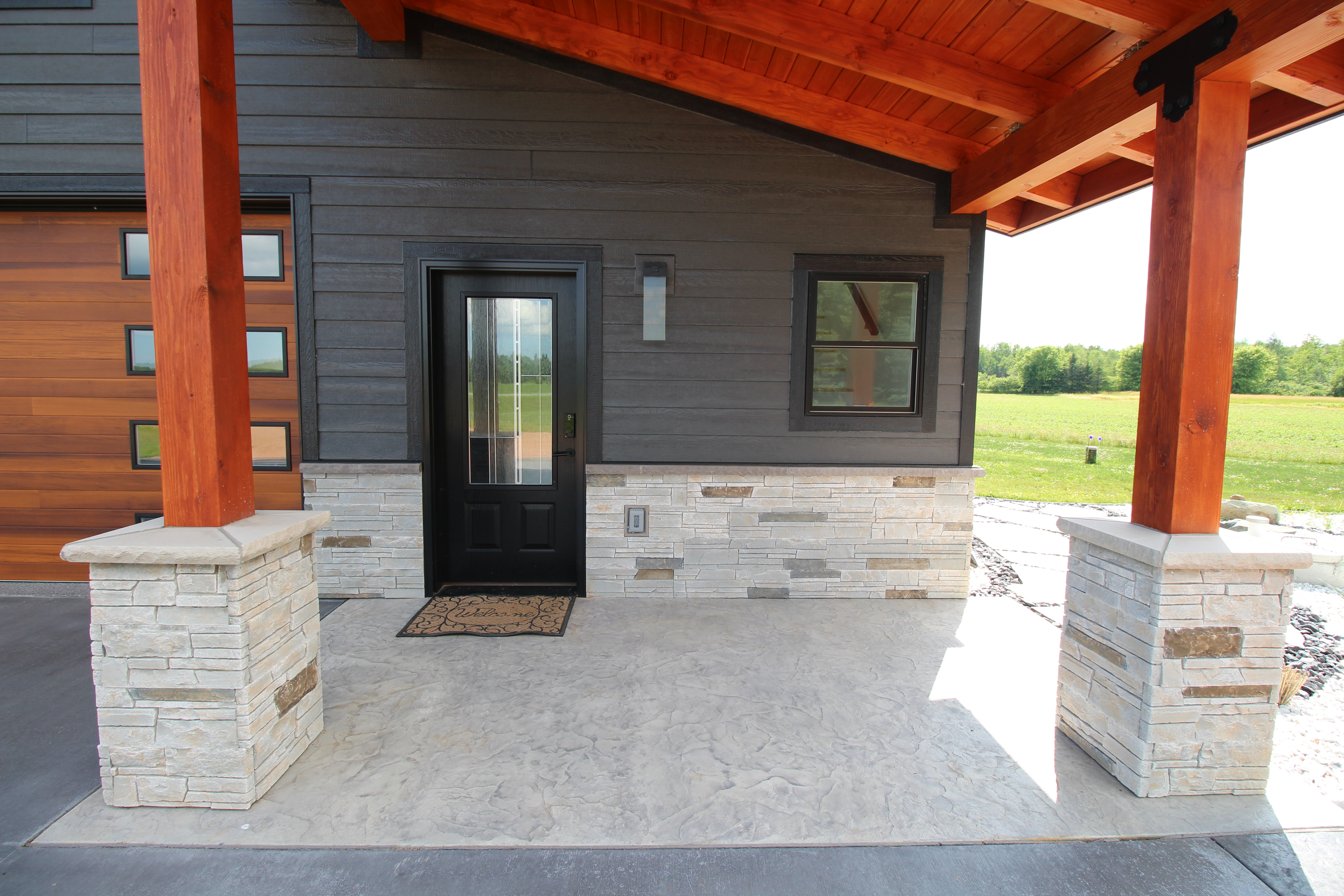
Concrete Step Repair and Porch Stoop Repair

Stamped concrete front entry between stone-wrapped porch columns

Front steps and stoops fail differently from flat slabs. They're small, they carry every trip in and out of the house, they're attached to a building that doesn't move while the step does, and they take shoveling and salt at the edges all winter. Most calls about concrete steps come in for one of the four problems below.

Crumbling Concrete Step Edges

The nosing, the front edge of each tread, takes shovel blades and salt and is usually the first thing to go. If the step underneath is sound, the loose concrete is chipped back, the edge is formed, and a repair mortar rebuilds the nosing square. Done right it holds; feathered to a thin skin it flakes off again by spring.

Concrete Step Separating From the House

A gap opening between the top step and the foundation means the steps have settled or tipped, usually because they sit on backfill. If the gap is stable and the steps are still level, it gets a backer rod and sealant so water and ice stay out of it. If the steps are tipping toward the house or away from it, sealant won't hold them, and the question becomes what they're sitting on.

Frost-Heaved Concrete Stoops

A stoop that rises in winter and settles back in spring, catching the storm door, is moving with the frost. Wisconsin's Uniform Dwelling Code wants footings for stoops and landings below frost or at least 48 inches below grade, whichever is deeper, and stoops on shallower footings can't be tied rigidly to a house on deep footings without an isolation joint. A lot of older stoops were never built that way, and no patch on top changes what's underneath.

When a Concrete Stoop Needs Rebuilding

Repair the step when the concrete is sound and only the surface or an edge has failed. Rebuild it when it heaves every winter, has tipped, or is cracked through in several places. A rebuild means breaking out the old stoop and pouring it again on footings that meet current code. We'll tell you which one you have; patching a heaving stoop every spring costs more over a few years than doing it once.

Sources: Wis. Admin. Code SPS 321.16(1)(a) and SPS 321.15(1)(e).

When Concrete Repair Is the Wrong Call

Some problems look like repair jobs and aren't, at least not ours.

  • A whole slab that has sunk in one piece. Lifting it back up with foam or mudjacking can cost less than replacing it. That's a different trade and we don't do it, but if it's the better fix for your slab, we'll say so.
  • Cracks in a foundation wall. Those are a structural specialty, not flatwork, and we don't repair them.
  • A slab that's failing everywhere. Five panels of sealant and patches on a driveway that needs to come out is money spent twice. See concrete driveways or concrete patios for what a replacement involves.
  • A pitted or cracked floor inside the garage. Garage floors get salt dripped on them all winter and fail in their own ways; that's covered on our garage floor repair page.

Concrete Repair Season in Central Wisconsin

Repair materials are pickier about temperature than people expect. The polyurethane crack sealant data sheet we checked calls for air and concrete between 40 and 100°F. Cement-based repair mortars on state DOT approved lists commonly can't go down below 40°F, or when the forecast drops below 40°F within the next 48 hours. In Wausau that puts most crack sealing and patching between April and November, the same window as our pouring season, with the best sealing days in the mild weeks at either end.

A crack that shows up in January isn't an emergency in most cases. Take a photo, keep salt out of it, and book the repair for spring. If a broken step is a hazard now, call; we'll tell you what can be done safely until the weather allows a proper repair.

What Sets the Price of a Concrete Repair

We don't price repairs over the phone, because the same crack can be a one-hour job or the first sign of a base problem. What moves the number:

  • Linear feet of crack and how much routing it needs. Clean, open cracks go quickly; hairlines that have to be cut open first take longer.
  • Base work under a section replacement. Saw-cutting and breaking out a panel is predictable. How much soft soil is under it isn't, until it's open.
  • Access. A panel the concrete truck can reach costs less to pour than one in a backyard that has to be wheeled in.
  • Finish matching. Broom finish is simple. Exposed aggregate and stamped surfaces take more work to match and still won't match perfectly.
  • Repair or rebuild on steps. Rebuilding the nosings is a small job. A new stoop on code-depth footings is a much bigger one.
  • Small jobs carry fixed costs. A saw, a crew and a truck show up whether it's one crack or twenty, so grouping several repairs into one visit is cheaper per repair.

What a Concrete Repair Contractor Checks on the Visit

  1. Every crack, not just the one you called about: width, which side is higher, and whether it lines up with a joint.
  2. Where the water goes: downspouts, the pitch of the slab, and low spots that hold puddles. A lot of failed slabs are drainage problems first.
  3. The edges: what the slab was poured on, and whether the base has washed out from under it.
  4. Steps: whether they've moved, whether they're tied to the house, and how they're doing at the nosings.
  5. The options, in writing: seal it, patch it, replace a section, or leave it alone. Sometimes the last one is the answer.

Not Sure What Your Crack Means?

Send a photo or book a free visit. We'll tell you whether it needs us at all.

715-814-9520

Concrete Repair Questions

Most of our repair work is in Wausau, Weston, Rib Mountain, Rothschild, Schofield, Kronenwetter, Mosinee and Marathon City. Farther out, call and ask. For a small repair a long drive away, we'll be honest about whether someone closer makes more sense.

Often, yes. A crack roughly 1/4 to 1 inch wide on a flat slab, with both sides level and not growing, is a good fit for a self-leveling polyurethane crack sealant, with backer rod if it's deep. Clean and dry it first and do it on a mild day. If one side is higher or the crack keeps widening, filler won't fix the cause.

Same thing in everyday use. Cement is the binder inside concrete; driveways, walks and steps are concrete. When people ask for cement repair they almost always mean one of the repairs on this page.

Yes. Sealant comes in concrete gray and can be textured, but a sealed crack is still a visible line. The point of crack repair is keeping water and salt out of the slab, not making the crack disappear.

No to both. Lifting slabs with foam or mudjacking is a different trade, and foundation wall cracks are a structural specialty. If either is what your problem needs, we'll tell you rather than sell you a repair that doesn't fit.

Ask what they think caused the damage, what material goes in the crack (flexible sealant or rigid patch) and why, whether a section replacement includes fixing the base, and how they'll match the finish. A contractor who can't explain the cause is guessing at the fix.

Not well. Most crack sealants and repair mortars need the air and the concrete at 40°F or warmer, and the crack has to be dry and frost-free. Winter calls get booked for spring; if a broken step is a hazard now, call us and we'll talk through what's safe until then.

Sources: NOAA 1991 to 2020 climate normals for Wausau; Olek et al., Investigation of Anti-Icing Chemicals and Their Interactions with Pavement Concretes, Purdue/INDOT JTRP-2013/24; University of Nebraska–Lincoln Extension G1121; manufacturer data sheets for polyurethane crack sealant and cement-based repair mortars; Taylor, Concrete Pavement Surface Defects, Iowa State University National Concrete Pavement Technology Center (2023); Wis. Admin. Code SPS 321.

Get a Concrete Repair Estimate

Free on-site estimates for crack sealing, patching, section replacement and step repair.

715-814-9520

☎ Call Now Get Estimate